Clean code slows delivery
“Clean Code Slows Delivery” Is a Lie We Tell Ourselves to Justify Sloppy Engineering
Every few months, the same argument resurfaces, usually framed as a bold, pragmatic hot take:
“Clean code is a luxury.”
“We need to move fast; we can clean it up later.”
“Delivery velocity matters more than elegance.”
It sounds practical. It sounds business-oriented. It even sounds experienced. It isn’t.
This belief survives not because it’s correct, but because the damage it causes is delayed, distributed, and rarely traced back to the original decision. By the time the consequences are apparent, the people who made the call have often moved on.
As engineers and architects, we owe ourselves and our teams a more honest conversation.
Let’s Be Precise About What We’re Arguing Against
Before defending clean code, we need to eliminate the strawman. If by clean code you mean:
- Gold-plated abstractions
- Over-engineering for imaginary futures
- Applying patterns because a book said so
- Indirection without pressure
Then yes, that slows teams down. But that isn’t clean code. That’s cargo-cult engineering: copying the shape of good design without understanding its purpose. No serious architect is advocating for that.
Real clean code is not about aesthetics or ego. It is about risk management.
Clean Code Is About One Thing: Reducing the Cost of Change
Here is the uncomfortable truth many people avoid stating explicitly:
Delivery velocity is not about how fast you can add new code. It is about how fast you can safely change existing behavior.
Most systems don’t fail because they couldn’t ship version 1 quickly enough. They fail because version 17 became terrifying to touch.
Clean code optimizes for:
- Local reasoning: understanding behavior without loading the entire system into your head
- Predictable behavior: fewer surprises when you change something
- Controlled blast radius: changes stay where they belong
- Change isolation: volatility doesn’t leak everywhere
In other words, clean code keeps options open.
This idea is not new. It has been repeatedly articulated by people who have built and maintained real systems for decades, such as Martin Fowler, who visualized the trade-off clearly in what he called the Design Stamina Hypothesis.
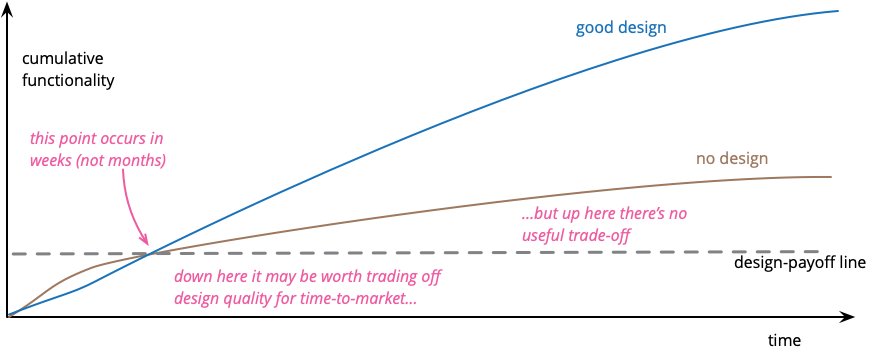 *Reference: https://martinfowler.com/bliki/DesignStaminaHypothesis.html*
Two curves tell the whole story:
- The “quick and dirty” curve rises sharply at the beginning
- The disciplined design curve starts slower
Then, usually weeks, not years, into a project, the curves cross. After that point, the “fast” team isn’t fast anymore. They are stuck.
“We’ll Clean It Up Later” Is a Professional Myth
In more than a decade of working on production systems, startups, scale-ups, and large enterprises, I have never seen this plan succeed. Not once. Why? Because “later” competes with:
- Roadmaps
- Deadlines
- OKRs
- Revenue pressure
- Team churn
And “later” always loses.
Technical debt is not paid down in a vacuum. It accrues interest, and that interest is paid immediately, often in ways teams misdiagnose:
- Pull requests slow to a crawl
- Code reviews become defensive instead of collaborative
- Regression testing expands from minutes to days
- Onboarding stretches from weeks to months
- Engineers quietly avoid entire areas of the codebase
This is how fear-driven development emerges:
“Don’t touch that module.” “Only Alex understands this part.” “It works, leave it alone.”
At that point, delivery velocity is already gone. You just haven’t updated the dashboard yet.
Local Speed vs. System Speed
This is where most debates go wrong.
Teams optimize for local speed:
- How fast will this ticket get closed
- How fast does this feature ship?
- How good this sprint report looks
But software delivery is not a task list. It’s a system.
System speed depends on:
- How many people can safely change the code in parallel
- How confidently can the system evolve
- How predictable releases are
- How often does production surprise you
Messy code doesn’t just add technical complexity; it also creates coordination overhead.
Every unclear boundary becomes a meeting. Every hidden coupling becomes a Slack thread. Every implicit assumption becomes tribal knowledge. Clean code reduces the social cost of software.
That’s why senior engineers feel the pain first, because they’re the ones paged at 2 a.m., onboarding new hires, and explaining why a “small change” took three weeks.
The Data Already Settled This Debate
If this were just an opinion, it would be one thing. But it isn’t. Years of research into software delivery performance, most notably the DORA studies, show the same pattern consistently:
High-performing teams have:
- Higher deployment frequency
- Lower change failure rates
- Faster recovery times
They do not trade quality for speed.
They invest in:
- Testability
- Readability
- Modularity
- Clear ownership
Messy code does not make you a startup hero. It makes you a long-term liability.
Discipline Is Not Dogmatism
There is a legitimate criticism buried inside anti–clean code rhetoric, and it’s worth addressing honestly.
Some teams absolutely over-engineer. Some architects absolutely over-abstract. Some codebases are strangled by premature generalization. But that is not an argument against clean code. It’s an argument against poor judgment.
Real clean code is pragmatic. It asks one question relentlessly:
What is the simplest structure that keeps this change cheap? Not:
- “How do we future-proof this?”
- “How do we make this enterprise-grade?”
- “Which pattern fits here?”
Just:
- What reduces risk right now, given what we actually know? That question requires experience, not dogma.
Architecture Is Not About Control, It’s About Optionality
One of the most misunderstood responsibilities of senior engineers and architects is this: Your job is not to predict the future. Your job is to make the future cheaper.
Clean code supports this by:
- Making behavior explicit
- Isolating volatility
- Protecting invariants
- Allowing systems to evolve without fear
When people say “clean code slows us down,” what they often mean is: “I don’t want to pay the upfront cost of thinking.” But thinking is not optional. You either do it before the system calcifies, or you do it during an outage with executives watching.
The Rewrite Is the Final Bill
There is a predictable endpoint to every “move fast, clean later” story. It’s called the rewrite. Rewrites are rarely acts of innovation. They are admissions of accumulated failure, failure to manage complexity incrementally, failure to invest in sustainability, failure to respect the economics of software.
And rewrites are always more expensive than continuous care.
The Real Trade-Off (Finally Stated Correctly)
So no, this debate is not: Clean Code vs. Velocity It is: Local Speed Today vs. System Speed Tomorrow
Experienced engineers know which compounds.
A Question for Senior Engineers
Be honest with yourself, not LinkedIn. When was the last time:
- Skipping quality
- Ignoring design
- “Just getting it done.”
Actually resulted in a system you were proud to maintain a year later? If the answer is never, then the debate is already over.
Final Thought
Clean code is not about being precious. It is about being professional. And professionalism in software is measured by how well your systems withstand the passage of time.
Pietro Cascio is a Senior Software Engineer and Pluralsight Author. He writes about the intersection of Java Architecture and Engineering Culture.