Legacy Code Isn’t About Age, It’s About Neglect
How brand-new systems quietly become unmaintainable, and what senior engineers can do to stop it.
Six months.
That’s how old the system was when I was asked to audit it.
It was proudly described as a greenfield, modern microservices architecture. New stack. New team. New start. The kind of project that’s supposed to avoid the mistakes of the past.
The first thing I did was turn on SonarQube, and not because I’m obsessed with tools, but because there weren’t any guardrails.
What showed up looked like this:
- 🔴 612 Reliability Issues
- 🔴 4,000+ Maintainability Issues
- 🔴 0.0% Code Coverage
- 🔴 33 Security Hotspots
- 🔴 7.5% Code Duplication
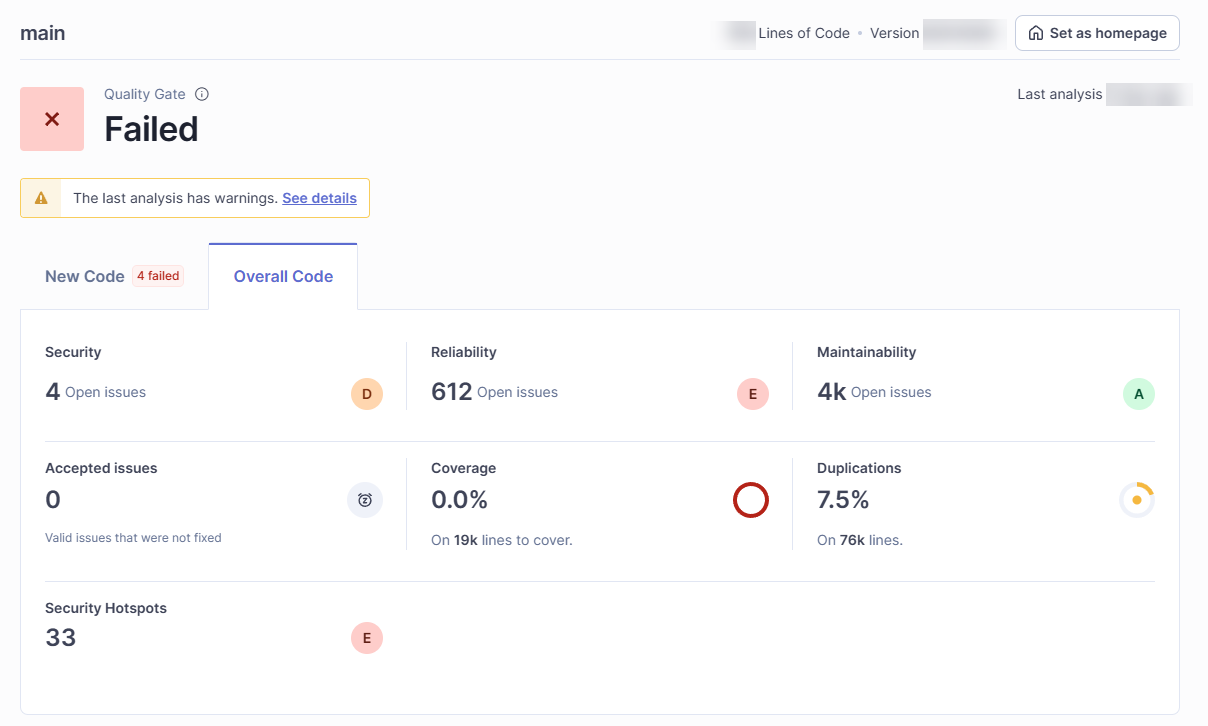
In under half a year, this system had accumulated more structural debt than some ten-year-old monoliths I’ve worked on.
That’s when the uncomfortable truth surfaced:
Legacy code isn’t defined by age. It’s defined by neglect.
The Myth of “We’ll Fix It Later”
When teams see results like this, the reflex is predictable:
- “We were under pressure.”
- “We needed to ship.”
- “It’s just temporary.”
- “We’ll clean it up once things stabilize.”
Sometimes those explanations are even accurate.
But here’s the part we don’t like to talk about:
Every system becomes what senior engineers tolerate early.
Accepting 0% test coverage in month one is not a temporary shortcut.
It’s an architectural decision.
Allowing unchecked duplication “just for now” is not pragmatism.
It’s setting entropy as a default.
Ignoring quality signals because “the business needs features” is not speed.
It’s borrowing against a future you will be forced to live in.
Architecture Is Not Diagrams, It’s Guardrails
We love to talk about architecture in abstract terms:
- Boxes and arrows
- Service boundaries
- Technology choices
- Cloud diagrams
But none of that stopped this system from decaying in six months.
Because architecture doesn’t live in slides.
Architecture lives in constraints.
In practice, architecture is the set of decisions that answer questions like:
- What happens if someone merges code without tests?
- What happens if complexity explodes?
- What happens if a service becomes a dumping ground?
- What happens if security concerns are “postponed”?
If the answer is “nothing happens”, then that is your architecture.
Quality Gates Are Not Bureaucracy
One of the most damaging beliefs in modern engineering is that quality gates slow teams down.
They don’t.
They surface reality early, when it’s still cheap.
Quality gates are automated expressions of intent:
- We don’t merge broken code.
- We don’t accumulate invisible debt.
- We don’t trade long-term viability for short-term momentum.
Examples of meaningful gates:
- Static analysis thresholds (complexity, duplication, code smells)
- Minimum test coverage that rises gradually over time
- Fail-the-build rules for critical reliability or security issues
- Explicit ownership of hotspots, not silent acceptance
These are not tools of control.
They are feedback systems.
Without feedback, systems don’t stay fast, they drift.
Tests Are Not About Confidence, They’re About Boundaries
A common misunderstanding is that tests exist primarily to catch bugs.
That’s only a small part of their value.
Tests are contracts.
They define:
- What behavior is stable
- What assumptions are safe
- What changes are allowed
- Where responsibilities stop
In distributed systems, especially, tests become the only enforceable boundaries you actually have.
Without them:
- Refactoring becomes fear-driven
- Changes become coupled by accident.
- Services rot into distributed monoliths.
- Teams slow down even though they’re “moving fast”.
0% test coverage doesn’t just mean “we didn’t write tests yet”.
It means:
There is no executable definition of correctness in this system.
That is not a technical gap.
That is a design failure.
The Speed Trap: Momentum vs. Delivery
There’s a dangerous illusion that early velocity equals success.
But speed without brakes is not delivery.
It’s momentum toward failure.
Early on, everything feels fine:
- Changes are easy (because nothing is stable)
- Refactoring is fast (because nothing is protected)
- Bugs are manageable (because usage is low)
Then usage grows.
Teams change.
Requirements shift.
And suddenly:
- Every change breaks something unexpected.
- Deployment becomes risky
- Lead time explodes
- “Just touching that service” becomes scary.
That’s when people say:
“It used to be so fast.”
It was never fast.
It was unprotected.
Clean Architecture Isn’t Purity — It’s Damage Control
This is why I obsess over Clean Architecture, and not as dogma, but as preventive care.
Clean Architecture doesn’t promise elegance.
It promises containment.
Its real benefits show up under pressure:
- Business rules don’t leak into frameworks.
- Tests don’t depend on infrastructure.
- Dependencies point inward, not outward.
- Volatility is isolated, not amplified.
Most importantly:
It keeps the cost of change flat longer than “just shipping” ever will.
When architecture is testable by design, decay becomes visible early, not years later during a rewrite no one planned.
Microservices Don’t Save You from Neglect
There’s a special irony when this happens in microservice systems.
Microservices are often chosen to avoid legacy problems.
But without discipline, they multiply them.
Instead of one decaying codebase, you get:
- Dozens of under-tested services
- Inconsistent standards
- Hidden coupling through data and behavior
- No single place where quality is enforced
Microservices amplify both good practices and bad ones.
If you don’t have guardrails, you don’t get flexibility.
You get distributed fragility.
The Senior Engineer’s Responsibility
This is the part that stings.
Legacy systems don’t usually fail because of juniors.
They fail because seniors didn’t draw lines early.
Not out of malice.
Out of empathy.
Out of “being pragmatic.”
Out of wanting to help the team move faster.
But architecture is not what you design.
It’s what you refuse to accept.
If you allow:
- No tests
- No quality signals
- No boundaries
- No consequences
Then you have designed a system that will decay very quickly.
What to Do Differently Next Time
If you want to prevent silent collapse, start here:
- Introduce feedback in week one
- Static analysis
- Basic quality gates
- Visible metrics
- Treat tests as architecture
- Not optional
- Not deferred
- Not “later”
- Raise the bar gradually
- Start achievable
- Tighten continuously
- Never reset to zero
- Make decay visible
- Dashboards
- Ownership
- Explicit trade-offs
- Remember what speed really is
- The ability to change safely
- Repeatedly
- Under pressure
Final Thought
Legacy code isn’t old code.
It’s code that no one protected when it mattered most.
Set guardrails early.
Fail fast on quality.
Make architecture executable, not aspirational.
Because every system eventually becomes exactly what its senior engineers tolerated at the beginning.
Pietro Cascio is a Senior Software Engineer and Pluralsight Author. He writes about the intersection of Java Architecture and Engineering Culture.