The wrong rule in the wrong place
Picture a Spring Boot service that manages its schema with Flyway. Two teams adopt the same coding agent and worry about the same thing: the agent editing a migration that has already run.
The first team writes "Don't modify existing migrations" in the project instruction file. Weeks
later, a reviewer spots that the agent rewrote V3__add_invoice_status.sql to fix a column type.
The instruction was there. The agent read it. It still made the edit.
The second team learns from that and blocks all writes to the migrations folder. Nothing gets
edited any more. Then a feature needs a new column, and the agent can't create V7 either.
The scenario is constructed, not recorded, but both failures will be familiar to anyone who has configured an agent. Last week I said that "don't touch the migrations folder" in an instruction file is a request, while a permission rule that blocks the write is a control. This week is about what follows from that. My argument:
The mistake is putting the wrong rule in the wrong place, and more instructions or more enforcement won't fix it.
Three mechanisms, three different jobs
It's tempting to rank the options: instructions are weak, enforcement is strong, a human is the final word. That ranking is what produced both failures above. The mechanisms don't sit on one scale, because each does a different job.
An instruction steers. It tells the agent what you expect, so it tries the right thing first and wastes fewer turns finding out what you'd reject. An agent that knows the migrations are off-limits will usually go and write a new one, which is what you wanted.
Enforcement guarantees, within its perimeter. A permission rule, a hook or a CI check holds whether or not the model was paying attention. But it only covers the operations it intercepts and the conditions it can check.
A human decides. Some questions aren't checks at all. Whether a schema change is acceptable, or whether a destructive migration is worth the risk, needs someone with the context and the authority to say yes.
An instruction is not a guarantee
The two teams both thought about the risk: migrations getting damaged. That's too coarse to place a rule on. What you can place a rule on is a specific property you want to hold, and each property needs an identifiable owner.
In the Flyway service, the risk area breaks down like this:
| Property or decision | Owner | Role |
|---|---|---|
| Applied migrations don't change | Flyway's validation, plus a CI check | Guarantee, within what they check |
| The agent doesn't try to edit them | Instruction in the project file | Steering, fewer wasted loops |
| A change needs a new migration, and that's acceptable | A person | Authority |
The first row depends on how Flyway validates. It already records a checksum for every SQL
migration it applies, and by default it validates them before migrating. Edit an applied file and
the next
migrate against that database fails. But it only checks against databases that have run the
migration. A fresh local database won't complain. That's why the CI check matters, and why it needs
a trustworthy reference: a protected baseline of which migrations count as immutable, not just
"whatever is on the main branch today".
So the rule is:
Every guarantee needs an identifiable owner: a mechanism, or a person when no mechanism can check it reliably. An instruction can't be that owner.
Several layers can support the same property. That's ordinary defence in depth. The mistake is asking one of them to carry a responsibility it can't hold, as the first team did when it asked an instruction to be a guarantee.
When enforcement is the wrong answer
The second team made the opposite mistake, and it's harder to accept if you assume more enforcement is always safer.
Strictness wasn't the problem with their deny rule. The boundary it protected was. The team cared about "files that have been applied may not change", and the rule enforced "nothing in this folder may be written". The folder rule is easy to express and blocks legitimate work. The applied-files rule is the actual requirement.
A rigid control on the wrong boundary has a cost the first team never paid: it blocks correct work, and an agent that still has a task to finish may look for another route to it, such as the shell.
Deciding where a rule goes
Here is the decision as I'd draw it, as three questions in this order:
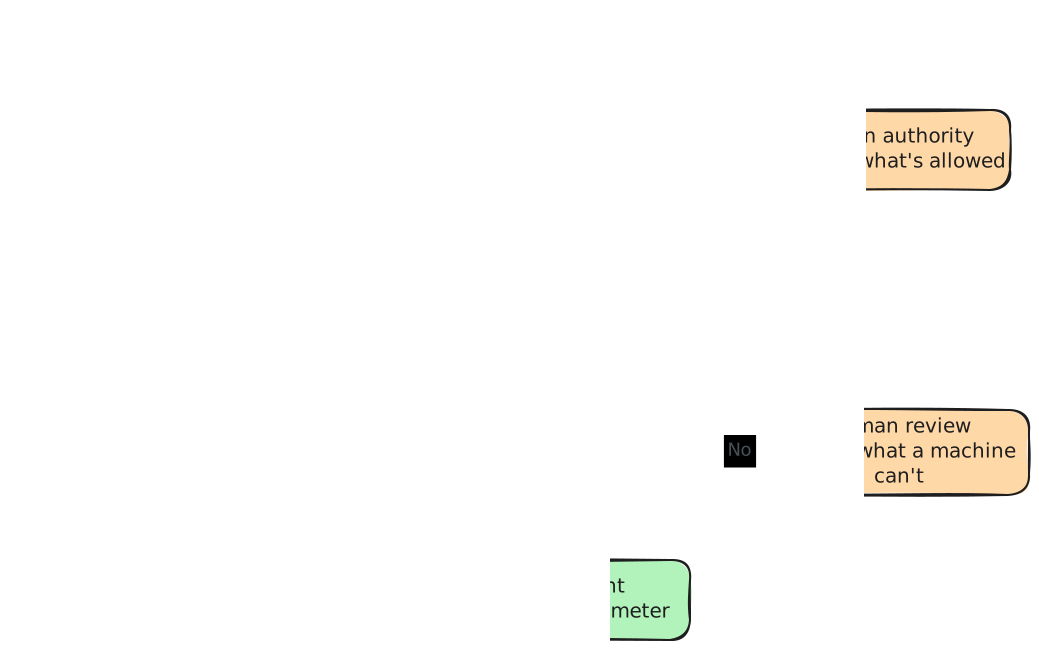
Authority comes first on purpose. Some things a machine can check still need a person to own the decision: approving a destructive migration is verifiable in the narrow sense and still not something to delegate.
When a violation would be unacceptable but no machine can check it reliably, stronger wording in the instruction won't help. A person has to review the result. Authority and review are different jobs: one decides what's allowed, the other checks what a machine can't.
The diagram identifies primary responsibility, not every supporting control. A human decision can still be backed by a check that blocks execution until approval exists.
"Human approval doesn't scale"
The strongest objection lands on that human column. Put an approval prompt in front of every action, and by the twentieth one you're clicking yes without reading. Approval fatigue turns oversight into a ritual.
That's true, and it supports this approach. If every action needs a human, the boundary is in the wrong place. Automate what can be verified. Pre-authorise what can be safely bounded, like creating new migration files or running the test suite. Keep human judgment for the decisions that actually need it, presented with enough context to judge.
Human authority also doesn't have to happen mid-run. A team policy that says "destructive schema changes need two reviewers before merge" is a human decision, made once, in advance.
What this looks like in Claude Code (October 2026)
Tool behaviour changes fast, so treat this as a dated example and check the official documentation before copying it.
Instruction. CLAUDE.md is loaded as context. The documentation is explicit: Claude "treats
them as context, not enforced configuration".
The over-broad boundary. A deny rule in .claude/settings.json:
{
  "permissions": {
    "deny": [
      "Edit(/src/main/resources/db/migration/**)"
    ]
  }
}
Edit rules apply to every built-in tool that edits files, including creating them, so this also
blocks the new V7. (A separate Write(...) rule isn't needed, and isn't matched.)
A narrower boundary. Instead of the deny rule, a PreToolUse hook matching Edit|Writereceives
the target path before the call runs. A short script blocks the call if the file is under the
migrations folder and already exists. New migrations go through; existing ones don't.
The perimeter. A PreToolUse hook scoped to Edit and Write does not cover changes made through
Bash. You can add one for Bash, but parsing shell commands is best-effort. The deny rule reaches
further: in my test it also blocked sed -i and a >> redirect on a migration. A Python one-liner
that opened the file itself still got through. That's why the Flyway
validation and the CI check stay: they own the guarantee; the hook just stops the agent wasting a
run.
The limit of this argument
Cost of failure, verifiability and authority are criteria you still have to apply with judgment. Teams will disagree on what counts as unacceptable, and a check that's reliable in one codebase is flaky in another.
What the criteria give you is a better question than "how do I make the agent obey?". The first recorded scenario in this series will use an instruction on purpose: "don't modify existing tests". It stays an instruction because a test can be genuinely wrong, and deciding when it is takes judgment. An instruction can be the right choice precisely because a rule has legitimate exceptions. It just shouldn't be mistaken for a guarantee.
As with every article in this series, the question underneath is the same:
What engineering decision changes this agent's behaviour, and what evidence tells us whether it helped?
Pietro Cascio is a Senior Software Engineer and Pluralsight Author. He writes about the intersection of Java architecture and engineering culture.